Born 8/5/1943, Tampere, Finland
Starts:1
Points: 0
Wins:0
Poles:0
Fastest Laps:0
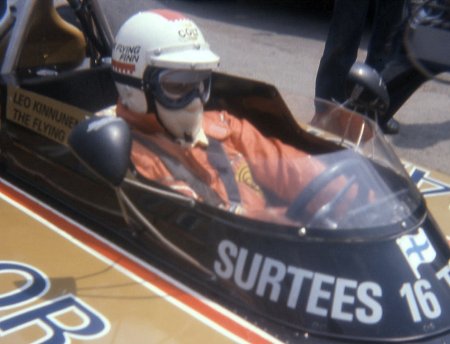
Curt Lincoln had been, until 1970, the only Finnish race driver of any international reputation. Curt did not go as far as Formula 1, after all, Finnish drivers were mostly known for their rally exploits. Leo Kinnunen made it to the upper echelons of motor racing in 1970, named Pedro Rodriguez’s partner at John Wyear Racing. He did well enough not to mess up the work of expert Rodriguez, and manage to manhandle the difficult Porsche 917 to four world championship victories. This was followed by three titles in the reasonably prestigious Interserie championship, supposedly the European equivalent of the Can Am series, from 1971 to 1973. For 1974, Kinnunen was to make the big move. The Finnish AAW Racing team decided to field their local hero in the F-1 championship, but the weapon of choice was anything but ideal: a Surtees TS16. Unfortunately for Kinnunen, his Formula 1 career comprised of 6 entries, with 5 DNQs. The only time he managed to qualify was in Sweden, where he started dead last, at 26th, and retired in the race. The 1974 GP entries were mostly oversubscribed, so there was no guarantee of starting a race, and Kinnunen posted the slowest time in three occasions, which happened to be the races with more entries [Belgium (32nd), England (34th) and Italy (31)]. So this was the end of Leo’s F-1 career, and he went right back to sports car racing for a few more years, before retiring for good. He holds the dubious distinction of being the last F-1 driver to race with an open face helmet. Finland would need to wait for Keke Rosberg to start its tradition of fast F-1 drivers.
Starts:1
Points: 0
Wins:0
Poles:0
Fastest Laps:0
Curt Lincoln had been, until 1970, the only Finnish race driver of any international reputation. Curt did not go as far as Formula 1, after all, Finnish drivers were mostly known for their rally exploits. Leo Kinnunen made it to the upper echelons of motor racing in 1970, named Pedro Rodriguez’s partner at John Wyear Racing. He did well enough not to mess up the work of expert Rodriguez, and manage to manhandle the difficult Porsche 917 to four world championship victories. This was followed by three titles in the reasonably prestigious Interserie championship, supposedly the European equivalent of the Can Am series, from 1971 to 1973. For 1974, Kinnunen was to make the big move. The Finnish AAW Racing team decided to field their local hero in the F-1 championship, but the weapon of choice was anything but ideal: a Surtees TS16. Unfortunately for Kinnunen, his Formula 1 career comprised of 6 entries, with 5 DNQs. The only time he managed to qualify was in Sweden, where he started dead last, at 26th, and retired in the race. The 1974 GP entries were mostly oversubscribed, so there was no guarantee of starting a race, and Kinnunen posted the slowest time in three occasions, which happened to be the races with more entries [Belgium (32nd), England (34th) and Italy (31)]. So this was the end of Leo’s F-1 career, and he went right back to sports car racing for a few more years, before retiring for good. He holds the dubious distinction of being the last F-1 driver to race with an open face helmet. Finland would need to wait for Keke Rosberg to start its tradition of fast F-1 drivers.




No comments:
Post a Comment